

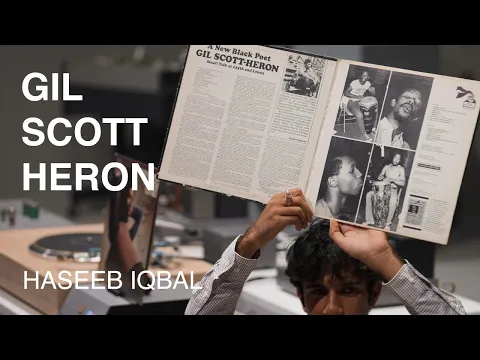
Broadcaster and DJ Haseeb Iqbal recently hosted an audience at 180 The Strand for a deep, vinyl-only session dedicated to the pioneering voice of Gil Scott-Heron. Surrounded by original pressings gathered from Midwest record shops, Iqbal unpacked the raw history, literary roots, and sharp political edge that defined Heron’s output throughout the 1970s.
Raw Roots on 125th and Lenox
Before full horn arrangements, Rhodes keyboards, and fusion basslines entered the picture, Gil Scott-Heron was purely a writer with a drum beat. As a 21-year-old student on self-imposed leave from Lincoln University, he approached producer Bob Thiele with a novel already published and a stack of poetry. With virtually no recording budget, Thiele paired him with percussionists Charlie Saunders and Eddie Knowles in Harlem to cut Small Talk at 125th and Lennox (1970).
Playing a first pressing found in Chicago, Iqbal highlighted the original, unaccompanied take of “The Revolution Will Not Be Televised.” This sparse early cut strips away all studio polish, presenting Heron’s voice alongside percussive traditions that trace directly back to African roots and the sharp street poetry of The Last Poets.
The Power of the Heavy Dance Floor
Heron built a lasting partnership with multi-instrumentalist Brian Jackson, yielding legendary cuts on albums like Pieces of a Man and Winter in America. Tracks like “The Bottle” and “Home Is Where the Hatred Is” pack crowded dance floors, yet their upbeat tempo masks raw reflections on personal and systemic addiction.
Iqbal pointed out that this contrast between infectious groove and harrowing commentary gives the music its staying power. It allows listeners to celebrate sound while confronting uncomfortable realities, creating a communal space where joy and grief coexist.
Why You Need to Watch the Full Session
A transcript only captures the words; it misses the sound of the needle hitting vintage wax on an audiophile sound system. Iqbal breaks down several other moments throughout the stream:
A quick, isolated synth phrase in Winter in America that Kendrick Lamar later sampled across an entire track.
The story of finding an original copy of Bridges (1977) in Detroit, alongside the chilling true history behind “We Almost Lost Detroit.”
In-depth commentary on how Heron’s work directly influenced the birth of early hip-hop.
Head over to The Vinyl Factory’s YouTube channel to watch the full performance, hear the record selections in sequence, and catch Iqbal’s track-by-track breakdown.